

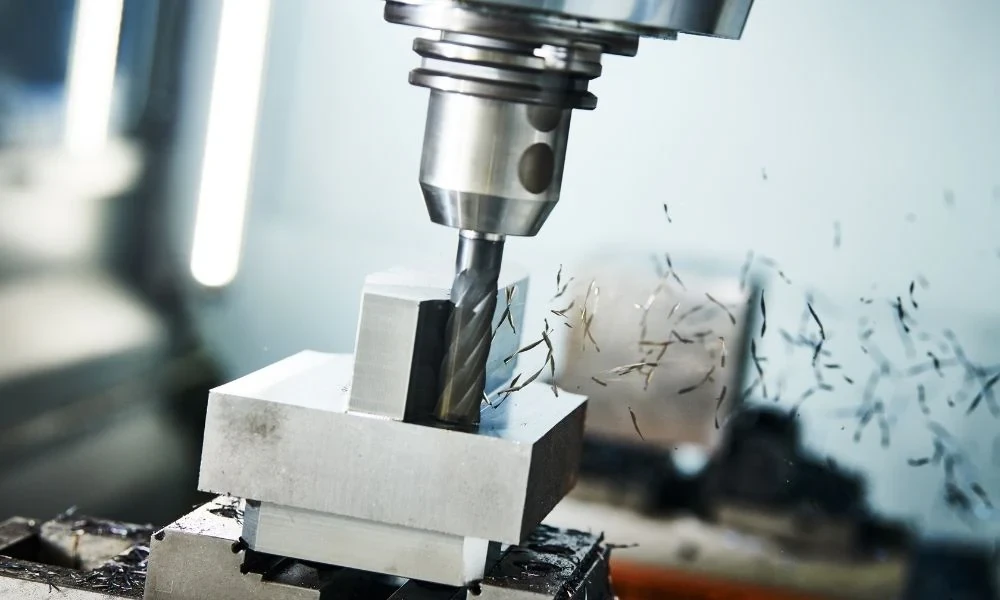
CNC turning, a cornerstone of modern manufacturing, has revolutionized the production of high-precision parts. This article provides a comprehensive overview of CNC turning-covering its core fundamentals, advantages, key operations, programming methods, and real-world industrial applications-along with how leading precision manufacturing partners like CS Rapid MFG bring these capabilities to life.
What is CNC Turning?
CNC turning is a subtractive manufacturing process in which a non-rotating, single-point cutting tool moves linearly against a rapidly rotating workpiece to remove material. This fundamentally differs from CNC milling, where the cutting tool itself rotates while the workpiece remains stationary. The acronym “CNC” stands for Computer Numerical Control, indicating that the machinery is fully automated and governed by pre-programmed computer instructions. These programs precisely dictate essential machining parameters, including tool motion paths, spindle speed, and feed rates.
In a standard CNC turning operation, a cylindrical bar of raw material is firmly secured in the lathe’s chuck. As the chuck rotates the workpiece at a designated RPM (rotations per minute), the cutting tool is fed into the rotating material, shaving off excess layers to achieve the intended geometry. Results range from simple cylindrical contours to complex profiles featuring varying diameters, tapers, threads, and internal grooves.
A standard CNC turning center consists of several key structural components:
- Bed: The rigid base that provides structural stability and absorbs vibration during operation.
- Headstock: Houses the main spindle and motor, driving the rotational motion of the workpiece.
- Tailstock: Supports the free end of longer workpieces to prevent deflection.
- Carriage: Moves the cutting tool precisely along the longitudinal and transverse axes.
- Turret: An indexable tool holder capable of mounting multiple cutting tools, allowing rapid tool changes within a single setup.
Key Advantages of CNC Turning
1. Exceptional Precision
The primary benefit of CNC turning lies in its extreme accuracy. Computer-controlled motion execution consistently achieves tight tolerances-often within a few thousandths of an inch (or micrometers). This level of precision is paramount in high-stakes fields such as aerospace and medical device engineering, where flawless fitment directly impacts system safety and performance.
2. Superior Repeatability and Consistency
Once a CNC program is compiled and verified, the machine can execute the exact same cycle indefinitely with virtually no variance. This high repeatability makes CNC turning ideal for both rapid prototyping and mass production. For example, automotive manufacturers rely on CNC turning to produce engine components like pistons, camshafts, and crankshafts, ensuring uniform performance across thousands of vehicles.
3. High Efficiency and Reduced Labor Costs
CNC turning centers can operate continuously with minimal human intervention, significantly increasing throughput while lowering direct labor expenses. Furthermore, multi-station turrets and modern live-tooling lathes enable multiple machining operations (such as facing, roughing, finishing, and threading) to occur in a single clamping setup, dramatically reducing cycle times.
4. Broad Material Versatility
CNC turning accommodates a broad spectrum of materials. It is routinely used to machine metals (including stainless steel, aluminum, brass, titanium, and alloy steels), engineering plastics (such as PEEK, Nylon, Delrin, and PTFE), and advanced composites.
Common CNC Turning Operations
CNC turning encompasses several distinct operations depending on the desired part geometry:
- Facing: The tool moves perpendicular to the workpiece’s axis of rotation to cut a flat surface at the end of the stock, establishing a clean datum face for subsequent measurements.
- OD (Outer Diameter) Turning: The tool travels parallel to the axis of rotation along the outer surface of the part, reducing its overall diameter and forming cylinders, tapers, or shoulders.
- ID (Inner Diameter) Turning / Boring: Used to enlarge, refine, or finish pre-drilled internal holes. Boring demands strict accuracy to maintain concentricity, tight tolerances, and high-quality internal surface finishes.
- Grooving: A specially shaped tool plunges into the workpiece to cut narrow channels or recesses, often used for retaining rings, O-rings, or aesthetic features.
- Threading: The tool follows a synchronized helical path along either the internal or external surface of the workpiece to cut standardized screw threads.
Programming Methods for CNC Turning
Precise programming is essential for executing successful turning cycles. Programming generally falls into two categories:
1. Manual Programming (G-Code)
Manual programming involves writing code directly in the machine tool’s native language using standardized commands such as G00 (Rapid Positioning), G01 (Linear Interpolation), and G02/G03 (Circular Interpolation). While manual coding requires deep domain knowledge, it remains effective for simple geometries or quick on-machine adjustments.
2. Computer-Aided Manufacturing (CAM) Programming
CAM software streamlines programming for complex geometries. An engineer imports a 3D CAD model into the CAM environment, defines the machining parameters, and allows the software to automatically calculate toolpaths and output optimized G-code. CAM programming dramatically cuts preparation time, minimizes human error, and optimizes tool engagement strategies.
Industry Applications & Manufacturing Solutions by CS Rapid MFG
Owing to its speed, accuracy, and versatility, CNC turning is widely adopted across high-tech and industrial sectors:
- Aerospace & Defense: Precision turbine shafts, landing gear components, and custom hydraulic fittings.
- Automotive & Robotics: High-volume powertrain elements, custom axles, bushings, and robotic arm joints.
- Medical & Dental Devices: Precision surgical instruments, implants, and diagnostic equipment hardware crafted from biocompatible metals and plastics.
- Electronics & Consumer Hardware: Intricate connectors, custom heat sinks, watch cases, and sensor housings.
On-Demand CNC Machining Services with CS Rapid MFG
To turn complex digital designs into physical components with speed and precision, partnering with an experienced precision manufacturer is essential. CS Rapid MFG (CS Mold Co., Limited) is an ISO 9001:2015 certified global manufacturing supplier specializing in high-precision CNC machining (including 3-, 4-, and 5-axis CNC milling and advanced CNC turning), rapid prototyping, sheet metal fabrication, and on-demand production.
Equipped with over 80 state-of-the-art CNC processing units and backed by a skilled technical engineering team, CS Rapid MFG provides complete, one-stop custom machining solutions:
- Strict Quality Control: Adherence to ISO quality standards with DFM (Design for Manufacturability) analysis provided prior to production.
- Flexible Volume Capabilities: From low-volume rapid prototypes (with fast turnaround times in as little as 3-5 days) to high-volume end-use production, with no minimum order quantity (NO MOQ) required.
- Comprehensive Precision Services: Seamless integration of CNC turning, milling, rapid tooling, and post-processing to ensure tight tolerance requirements and superior surface finishes.
For more information or to request a 12-hour instant quote for your custom CNC turning project, visit CS Rapid MFG.
Conclusion
CNC turning remains an indispensable technology in modern precision engineering. By combining high accuracy, exceptional repeatability, material versatility, and continuous automated operation, CNC turning empowers global industries to bring high-performance designs into reality efficiently. Partnering with qualified manufacturing leaders like CS Rapid MFG ensures that these technical advantages translate directly into dependable, high-quality finished products.
